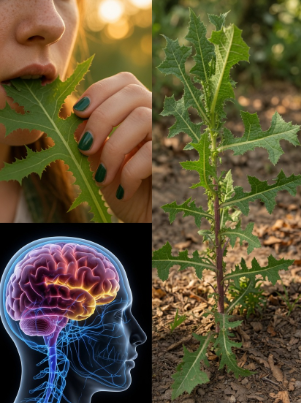
If you have a garden, a small yard, or even a patch of dirt near your driveway, chances are you’ve seen this plant.
You might have even tried to pull it out, thinking it was just an annoying, prickly weed.
But in the world of traditional healing and modern herbalism, this leaf isn’t a weed—it’s liquid gold.
I’m talking about Wild Lettuce (often confused with its cousin, Dandelion, or the common Thistle). Specifically, the variety known as Lactuca virosa or Lactuca serriola. For centuries, it has been known by another, more mysterious name: “Poor Man’s Opium.”
Don’t let the name scare you. It’s not a drug, and it’s not addictive. It earned that nickname because of its incredible ability to soothe pain, calm the nervous system, and induce deep, restorative sleep—all without the side effects of modern pharmacy pills.
The Hidden Power Inside the Spikes
When you look at this plant, it doesn’t look like much. It has long, serrated leaves with tiny, soft prickles along the spine and edges. But the secret isn’t just in the leaf itself; it’s in the milky white sap that flows through its veins.
=
If you snap a leaf or break the stem, you’ll see a thick, white liquid ooze out. This substance is called Lactucarium. This is the “gold” I’m talking about.
Lactucarium contains high concentrations of bitter compounds that act directly on the central nervous system. While most modern medicines try to mask pain by blocking signals, Wild Lettuce works by gently relaxing the entire body, allowing the nervous system to “downshift” from a state of high alert to a state of healing.
3 “Secret” Benefits of the Leaf in Your Compound
Most people who know about Wild Lettuce only know it for pain. But there are three specific, lesser-known ways this “backyard gold” can transform your health that most doctors won’t tell you about:

1. The “Nerve Switch” for Anxiety
We live in a world of constant blue light and high stress. Our nervous systems are perpetually stuck in “fight or flight” mode. Wild Lettuce contains sedative properties that help reset the vagus nerve—the long nerve that connects your brain to your gut and controls your relaxation response. A small cup of tea made from these leaves before bed doesn’t just make you sleepy; it physically “unwinds” the tension stored in your neck and spine.
2. The Respiratory Rescue
Few people realize that Wild Lettuce was historically used to treat “whooping cough” and severe asthma. It acts as an antispasmodic, which means it helps relax the muscles in the bronchial tubes. If you have a dry, hacking cough that keeps you up at night, the compounds in this leaf help quiet the cough reflex, allowing your lungs to rest and recover.
3. Joint Mobility and Inflammation
Because of its bitter profile, Wild Lettuce is a natural anti-inflammatory. Many older generations used to apply the crushed leaves as a poultice directly onto swollen knees or arthritic hands. The sap penetrates the skin to reduce localized inflammation, providing relief that feels cool and soothing rather than the “burning” sensation of many store-bought creams.
How to Use Your Backyard Gold (Nana’s Traditional Way)
If you find this plant in your compound, don’t just start eating the leaves like a salad. They are incredibly bitter—some say the most bitter thing they’ve ever tasted! Instead, follow these traditional methods to extract the medicine safely:
- The Dried Leaf Tea: Harvest the leaves in late summer when the plant is tall and about to flower—this is when the sap is strongest. Dry them in a cool, dark place. Use just one teaspoon of dried leaves per cup of hot water. Let it steep for 10 minutes. Warning: It will be bitter! Add a little honey to help it go down.
- The “Sap Extract” (The Most Potent Method): Collect the white sap by snapping the stems and letting the liquid drip into a small glass jar. Once you have a small amount, you can let it dry into a resin or mix it with a high-proof alcohol to create a tincture. Just 2–3 drops are often enough to help with chronic pain or insomnia.
- The Infused Oil: Place fresh, crushed leaves in a jar and cover them with olive oil. Let the jar sit in a sunny window for 4–6 weeks, shaking it daily. Strain out the leaves, and you’ll have a powerful “pain oil” to rub into sore muscles and joints.
A Word of Caution: Know Your Leaves
Before you go foraging, it is vital to identify the plant correctly. Wild Lettuce has a central spine on the underside of the leaf that is covered in small, hair-like prickles. If the spine is smooth, it might be a different plant. Always consult a local foraging guide or a trusted herbalist before consuming anything from the wild.
Also, because it is a natural sedative, never use Wild Lettuce before driving or operating heavy machinery.
Why We’ve Forgotten the “Gold”
In the 19th century, Wild Lettuce was a staple in every apothecary and home medicine cabinet. But as synthetic drugs became easier to mass-produce and patent, the “weeds” in our yards were labeled as nuisances rather than nutrients.
The truth is, nature provides exactly what we need, often right where we live. The next time you see that spiky, tall “weed” leaning against your fence, stop and look closer. You aren’t looking at a mess that needs to be cleared—you are looking at a gift that can heal.
Have you ever noticed this spiky leaf in your yard? Did you know its “secret” history, or did you almost pull it out? Let’s talk about your favorite “backyard remedies” in the comments! 


