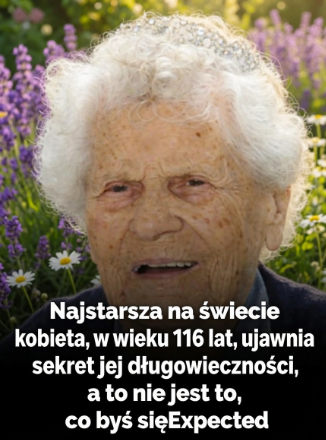
JesteWe are obsessed with the “how.” We spend billions on anti-aging creams, biohacking supplements, and 5 AM ice baths, all in hopes of stretching our time on this planet.
But when you sit across from Ethel, the 116-year-old woman who currently holds the title of the world’s oldest living person, you realize we’ve been looking in the wrong direction.
Ethel doesn’t have a personal trainer. She doesn’t have a “superfood” smoothie recipe.
In fact, when you ask her how she managed to navigate 1,392 months of human history—through world wars, the invention of the internet, and a global pandemic—she doesn’t point to her kitchen or her medicine cabinet.
She points to her temperament.
In 2026, as the world moves faster than ever, Ethel’s secret is a radical “pattern interrupt.” It is a truth so simple it feels like a secret, and it’s something most of us have forgotten how to do.
1. The “Weight” of Longevity: Keeping Life Light
Most people assume that to live to 116, you must have a “iron-clad” routine. But Ethel’s philosophy is the opposite: Flexibility.
The Anti-Tension Rule: Ethel believes that the physical body reacts to “mental knots.” If you carry anger, your muscles tighten. If you carry resentment, your heart works harder. She speaks often about “keeping life light”—choosing to let go of unnecessary tension before it settles into the bones.
=
Pleasure Without Guilt: In an era of restrictive dieting, Ethel is a rebel. She allows herself moments of pleasure—a piece of chocolate, a slow cup of tea, a sweet biscuit—without a second of guilt. She believes that the stress of “denying” yourself is more toxic than the sugar itself.
Protecting the Peace: For Ethel, inner peace isn’t a luxury you find on a yoga retreat; it’s a daily necessity. She insists that life becomes “heavy” only when we insist on carrying worry that doesn’t belong to us.

2. The 1909 Perspective: Curiosity Over Fear
Born in 1909 in the south of England, Ethel’s life is a masterclass in adaptability.
The Original Digital Nomad: Long before “gap years” were a trend, a young Ethel left her bustling household to work as an au pair abroad. This decision shaped her forever. It taught her that the world is wide, people are generally good, and “different” isn’t something to fear—it’s something to be curious about.
Witness to Change: She has seen the horse-and-carriage replaced by the electric car. Yet, those close to her say she never became cynical. While many people “harden” as they age, Ethel stayed “porous”—letting new ideas and technologies flow through her without letting them rattle her steady, quiet optimism.
3. The Pandemic Paradox: Calm in the Storm
One of the most remarkable chapters of Ethel’s life happened just a few years ago. When the global health crisis of the early 2020s hit, the world was terrified for its elders.
The Steady Pulse: While everyone around her was panicked, Ethel remained the calmest person in the room. She didn’t ignore the danger, but she refused to let the fear of the danger take up residence in her mind.
Trust vs. Control: Her family says her secret was a deep trust in life. She understood that worry is a “useless fuel”—it burns energy but doesn’t move the car. By staying positive and keeping perspective, she preserved the vital energy her body needed to stay healthy.
4. The “Social DNA”: Why Relationships Are the Real Superfood
Longevity runs in Ethel’s blood (one sister also lived past 100), but she credits “Social DNA” more than biological DNA.
The Power of Solidarity: Growing up in a house where sharing was the default setting, Ethel learned that we are “social animals.” She believes that isolation is the fastest way to age.
The Slow Taste: Ethel’s favorite phrase is that life “does not need to be rushed; it needs to be tasted slowly.” She prioritizes shared meals and laughter over grand achievements. In her eyes, a 2-hour conversation over a simple lunch is more “productive” for your health than a 10-mile run done in isolation.
5. Nana’s Wisdom: “Don’t Polish the Floor Until You’ve Danced on It”
Nana used to have a saying that reminds me exactly of Ethel: “You can spend your whole life cleaning the house so it’s perfect, but then you’ll realize you forgot to live in it.” Nana believed that “worrying about tomorrow is just stealing the joy from today.” She’d look at Ethel and say, “That woman isn’t old because she’s lived a long time; she’s young because she never let the world turn her sour.” Nana taught us that the secret to a long life wasn’t in the bottled water or the fancy vitamins, but in the “gentleness” we show ourselves when we fail. She’d say, “Be kind to your heart, and your heart will be kind to you.”
How to Live “Well” Instead of Just “Long”
Now living in a care residence, Ethel laughs when people mention her “record.” She never set out to be the oldest. She simply set out to be the kindest to herself.
Ethel’s lesson for 2026 is clear: Stop trying to control the clock.
Drop the anger.
Eat the chocolate.
Talk to a stranger.
And for heaven’s sake, slow down.
A long life isn’t built on perfection. It’s built on the quiet, steady choice to stay gentle in a harsh world.
Does Ethel’s “Gentle Secret” surprise you, or do you have a relative who lived a long life with a similar mindset? What is one “unnecessary tension” you are going to let go of tonight?
